

Do you know why Aluminum Formwork is widely chosen by reputable contractors?
You may think it is because aluminum formwork offers fast construction and a high-quality concrete finish.
That is correct.
But in my view, these benefits alone do not fully explain why aluminum formwork has become so popular.
So what makes aluminum formwork a complete solution for building construction?
This article will help you understand it clearly. Specifically, you will learn:
- What is aluminum formwork? When was it developed and how is it produced?
- What are the advantages and disadvantages?
- What other formwork systems can it be combined with?
- How is aluminum formwork developing in Vietnam?
- What is the future trend of aluminum formwork?
Let’s get started.
Nội dung chính:
What is Aluminum Formwork?

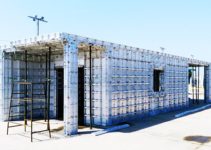
Aluminum formwork is a type of modular formwork. It is mainly made from Aluminum Alloy and offers high strength, light weight, durability and good non-stick properties.
Aluminum panels are connected together to create a complete formwork system for holding concrete during construction.
The components come in many sizes and are especially suitable for high-rise buildings and projects with repetitive floor layouts. This allows the system to be reused many times and helps reduce construction costs.
When did Aluminum Formwork come into being?
This form of formwork was developed based on Euro Form, a Steel formwork created in the 1960s in the United States.
In the late 1970s, a Canadian engineer W.J Malone developed Aluminum formwork panels as an alternative to steel formwork.
Early aluminum formwork systems were first used to build affordable housing in developing countries.
Further improvements helped reduce labor costs, shorten construction time and improve construction quality.

These advantages attracted the attention of formwork solution providers around the world. Many companies invested in research and started mass production of aluminum formwork systems.
What Aluminum Alloy is used to produce aluminum formwork?
Aluminum Alloy is an alloy of aluminum combined with other elements such as copper, tin, manganese, silicon and magnesium.
Two common Aluminum alloy types used for formwork are 6061 and 6063 because they offer good extrusion performance and flexibility.
Among them, 6061 alloy is often preferred because of its high strength, corrosion resistance and good welding properties.
Many aluminum formwork systems in Vietnam are mainly produced from this type of alloy.
Advantages of Aluminum Formwork systems
Light weight, durability and high flexibility are key advantages of Aluminum formwork systems.
Here are the main benefits.
#1. Lightweight & flexible
On average, 1 square meter of aluminum formwork weighs only about 20-27 kg.
With modern production technology, aluminum panels can remain lightweight while still providing the required load-bearing capacity.
The components are connected together to create a strong, stable and lightweight formwork system.

Easy handling and installation are major competitive advantages of aluminum formwork.
During construction, workers mainly install the panels according to design drawings and survey positioning.
The accessories used to connect aluminum components are also designed for easy installation while maintaining the required load-bearing capacity.
The bracing system is relatively simple and easy to adjust during construction.

The construction area remains open, clean and easy to work in.
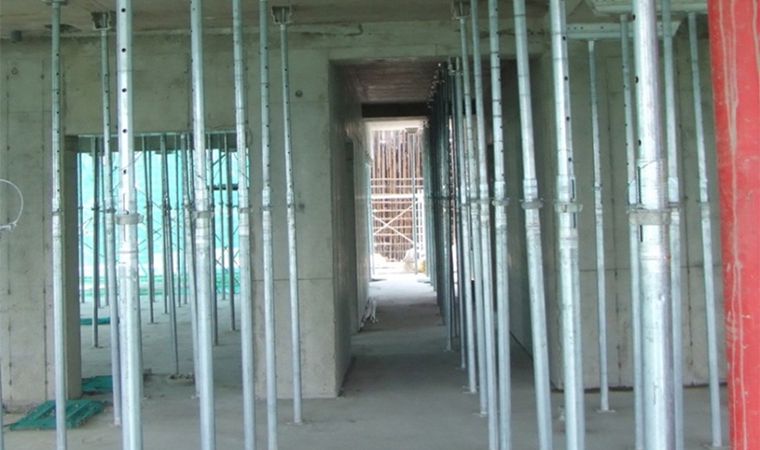
In addition, aluminum formwork reduces the time workers spend measuring, cutting and repairing materials compared with traditional formwork systems.
#2. Fast floor construction
The average construction cycle for one floor can be significantly reduced to only 3-5 days.
The system is designed with 3 levels of supports. After 24-48 hours, aluminum formwork can be dismantled in sequence from walls, beams and slabs, while the support system remains in the following 2 floors.

This helps contractors better control and shorten the overall construction schedule.
According to construction time surveys using aluminum formwork, it can accelerate the project progress by more than 30%.
#3. High reusability
Each set of aluminum formwork can be reused more than 100 times, or across about 2-3 projects. This can significantly reduce costs for construction contractors.
Standard formwork panels are carefully designed and checked, which improves their ability to be reused on future projects.
With proper maintenance and dismantling, the damage rate can be limited to about 5-10%, although it may gradually increase after repeated reuse.
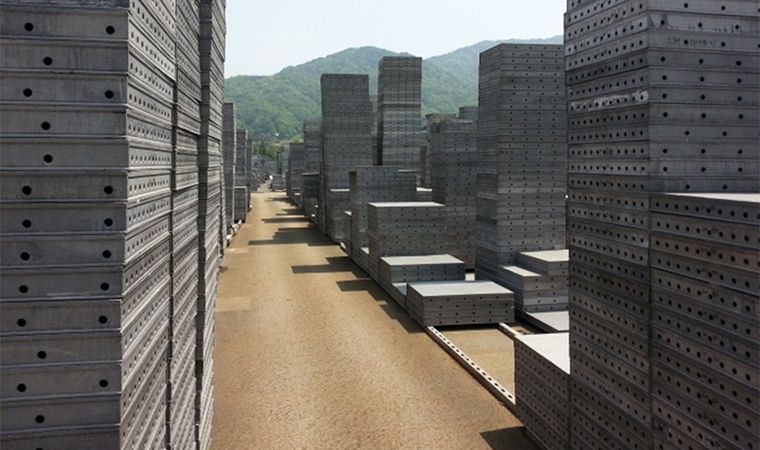
Another advantage of aluminum formwork is its high dimensional accuracy and smooth concrete finish. This can significantly reduce repair and finishing costs.
Concrete surfaces cast with aluminum formwork often do not require plastering like traditional formwork. In many cases, sanding and painting are enough for finishing.

However, aluminum formwork still has some limitations that can create barriers for small and medium-sized contractors.
Let me explain them in more detail.
Disadvantages of Aluminum Formwork system
- The price of aluminum formwork is higher than many other types of formwork, so the initial investment cost can be high.
- Its application is more suitable for high-rise buildings and projects with repetitive or typical floor designs.
- It can be difficult to modify or repair if the design is incorrect or construction requirements change.
- Contractors need good management, supervision and inventory control to get the maximum benefits from aluminum formwork.
You may now understand why aluminum formwork offers many important benefits.
These advantages have helped aluminum formwork become widely used in Vietnam.
However, these benefits alone do not fully explain its strong development in the construction market.
The key point is explained in the next section.
The systems combined with Aluminum Formwork systems
Aluminum formwork already offers many advantages. However, construction technology continues to develop, so the system also needs to improve.
New production technologies help aluminum formwork meet complex architectural and construction requirements while maintaining structural accuracy.
The ability to combine with other formwork systems also increases flexibility and helps aluminum formwork remain competitive in the market.
Here are some common combinations that have improved the performance of aluminum formwork:
#1. Formwork system climbing: Gang form
Gang form uses large steel panels combined with a frame and working platform to form the external concrete surfaces of high-rise buildings.
On the inside face of the building, Euro form or Aluminum formwork is commonly used. Aluminum formwork is often the more popular choice.

The combination of gang form and aluminum formwork provides several important advantages:
- Using the advantages of aluminum formwork for fast and accurate construction.
- Gang form can significantly reduce or remove the need for external scaffolding around the building.
- Helping speed up both structural construction and finishing work.
#2. Auto Climbing Systems (ACS)
These systems have different names such as climbing formwork, jumping formwork or sliding formwork. Here I collectively refer to them as Climbing Systems.
Climbing Systems can replace scaffolding and boundary formwork around the building or inside the building core.
The system is operated by hydraulic jacks or tower cranes. Depending on the design, aluminum formwork may or may not be used for the boundary formwork.
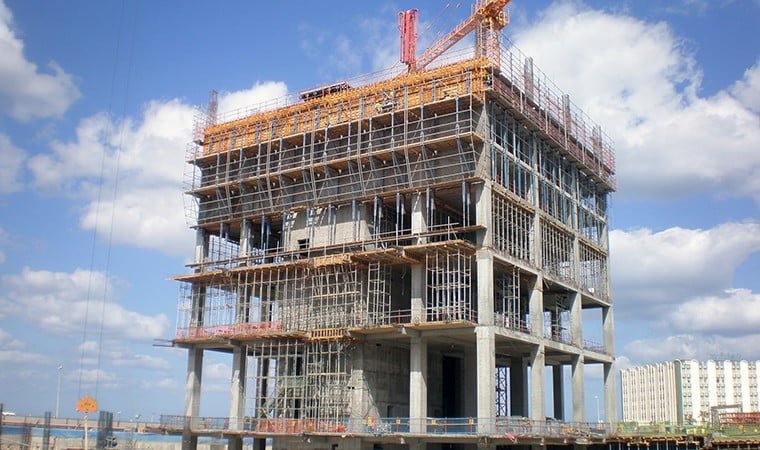
Gang form is also a type of climbing system.
#3. Beam Drop Systems
This system helps replace or reduce the number of individual supports. It uses bracing bars to support the aluminum slab formwork system.
This can help speed up construction, reduce noise and improve site safety.

This technology is widely used in Korea and Japan. However, it has not been widely applied in Vietnam because of specific conditions such as floor height and slab span.
#4. Couple: Aluminum formwork & Traditional formwork (plywood)
Using aluminum formwork and traditional plywood formwork in the same building may not be considered the latest construction technology compared with the systems mentioned above.
But from the perspective of contractors moving from traditional formwork to aluminum formwork, this is a practical choice.
According to our survey, both small and large construction contractors often choose a gradual transition when they first start using aluminum formwork.
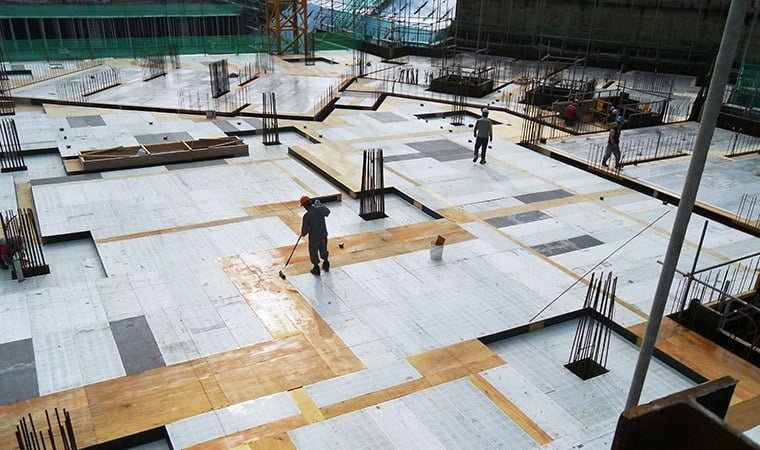
In this solution, aluminum formwork and plywood formwork are used together on the same building.
This allows contractors to gradually adapt their construction methods according to their management and financial capacity.
The ability to adapt to different construction methods is another important advantage that helps aluminum formwork continue to develop.
So, how has aluminum formwork developed in Vietnam?
Situation of development of Aluminum Formwork in Vietnam
Aluminum formwork entered Vietnam around 2010 with the presence of Korean companies. It gradually established its position as a reliable solution for high-rise construction.
As the market continued to develop, many domestic and foreign companies also entered the aluminum formwork market from around 2016.
The fierce competition among companies provides Aluminum Formwork
Some well-known brands include Kumkang, Sammok, Hyundai,…
Each company has its own strengths. Korean companies are often known for aluminum alloy quality, while Vietnamese companies may have an advantage in product pricing.
Some leading construction companies such as Coteccons and Hoa Binh also developed related companies to optimize formwork use. This also allows more processing and production work to be managed within their own system.
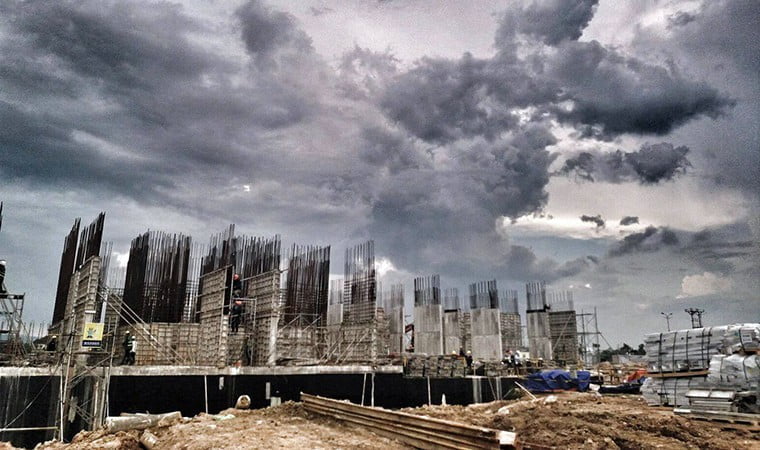
To meet construction demand in Vietnam and contractor requirements, manufacturers continue to improve aluminum formwork specifications, panel sizes, calculations, accessories, design drawings and materials.
Many suppliers also compete through discounts and improved services.
The price of Aluminum Formwork is continuously lowered
I cannot provide the exact selling or rental prices of specific suppliers. Doing so could create unnecessary misunderstandings and may not reflect actual contract conditions.
I also do not have complete pricing information from every supplier. However, I can explain the main factors that affect aluminum formwork prices.
These are the main factors that affect the price of aluminum formwork:
- Market competition at a specific time.
- The business relationship between the parties.
- Duration of use and construction difficulty.
- Standard and non-standard components.
- Rental prices may be calculated per square meter of aluminum formwork and according to the rental period.
- Installation support, equipment and spare parts may be charged separately or included depending on the contract.
- Accessories may or may not be included in the contract price.
- Accessories usually account for about 5-15% of the total value of aluminum formwork.
According to my survey:
- The selling price of aluminum formwork ranges from 90-105 USD/m2.
- Rental prices are about 30-50% of the selling price.
At the time of this survey, buying new aluminum formwork was not as common as it had been in 2015 and earlier.
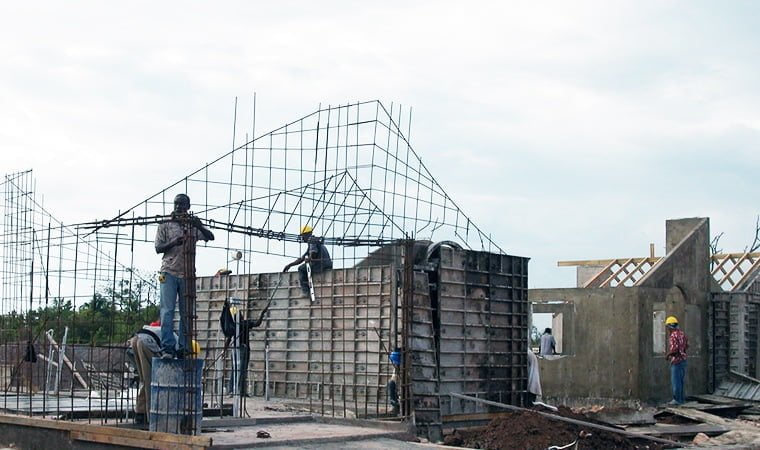
I will explain the reason below.
The tendency to rent Aluminum Formwork increases
When buying new aluminum formwork, contractors need to manage maintenance, storage, inventory control and supervision. They also need to consider losses from damaged components.
Renting requires a lower initial cost. Contractors can also continue renting the system for the next project to reduce the unit cost, while maintenance and logistics may be handled by the supplier.
Therefore, renting aluminum formwork has become an important trend in Vietnam.
Construction of common high-rise buildings with Aluminum Formwork
In my 2019 article about Aluminum formwork solutions, I noted that more than 70% of high-rise buildings were constructed using aluminum formwork and related systems.

Leading construction companies such as Hoa Binh and Coteccons have also used Aluminum formwork for villas and adjacent houses.
To remain competitive, construction companies continually look for faster and more efficient construction methods.
At that time, aluminum formwork was one of the leading solutions for these types of projects.
So, what could happen to aluminum formwork in the Vietnamese market in the future?
Here is my view.
Does Aluminum Formwork continue to flourish in the future?
Like any fast-growing construction technology, aluminum formwork may eventually experience slower growth or stronger competition after reaching a high point.
So what factors could slow the development of aluminum formwork?
In my opinion, there are several important factors:
- Saturation of the real estate market and repeated real estate cycles.
- Changes in regulations related to the import, export and production of aluminum alloys.
- Unhealthy competition between suppliers.
- The entry of strong new competitors.
According to industry information at the time, several major aluminum formwork companies were also considering entering the Vietnamese market, including Chinese companies.
With high supply in their domestic market, these companies were looking for new markets, including Vietnam.
If they expand strongly into Vietnam, competition in the aluminum formwork market could become much more intense.
Strong competition may push prices lower and create a new market cycle before another period of growth.

At the same time, modern construction technologies from Western countries continue to influence construction methods in Vietnam. Integration and technological development are natural trends.
No one knows whether Aluminum formwork could eventually be partly or completely replaced by other systems such as Table or flying form systems, Tunnel forms, Formwork Climbing, Flexible formwork, Cassette formwork, Plastic formwork.
Conclusion
This article provides an overview of aluminum formwork, from basic concepts and materials to advantages, disadvantages, combined systems, pricing and market development.
Many of these points may also apply to aluminum formwork markets in Korea, India, Malaysia, Thailand, China and other countries around the world.
Do you have any questions? Or do you have another point of view?
Let me know by leaving a comment below. We can discuss it together.
If you like this article, don’t forget to share it. Thank you!
***This is the English version of the Vietnamese article: Tổng quan về cốp pha nhôm

(Bài viết được cập nhật vào 26/09/2026)


Dear sir
Good morning and have a great day.
It is pleasure to write to you for establish business relations with you.
we are professional aluminum formwork accessories manufacturer and exporter of China. our factory established in 2005, we have more than 15 years production experience. the main products as bellow:
Pin and wedge
al-bracket
tie nut and tie rod
square washer.
welcome you inquiry. we are really factory and we can help you save much cost if we can cooperate with each other.
I am looking forward to you inquiry soonest.
Best regards.
Sophia
Dear Sophia,
Have a nice day.
We are happy to hear from you.
Aluminum formwork market VN we are also consuming a large amount of accessories.
Therefore, it is essential if you can send us:
– Pictures of aluminum formwork system in use in China.
– Some catalogs of aluminum formwork systems in your country,
– Especially, your company’s accessory catalog,
I ask you for these documents because as far as I know, the aluminum formwork system of Vietnam and China has some differences, for ex:
– Specification of hole, flat tie, …
– Specification of formwork connection,
– Material properties, bearing capacity of aluminum formwork,
Thank you for sharing this information with us.
Best regards.
i am a bloger, not supplier or corp.
Sorry im can not help you.
Do you produce Tie for Alminum Form in Vietnam?
If so, we like to know your pricing…
Do you import materials from China and press in Vietnam?